

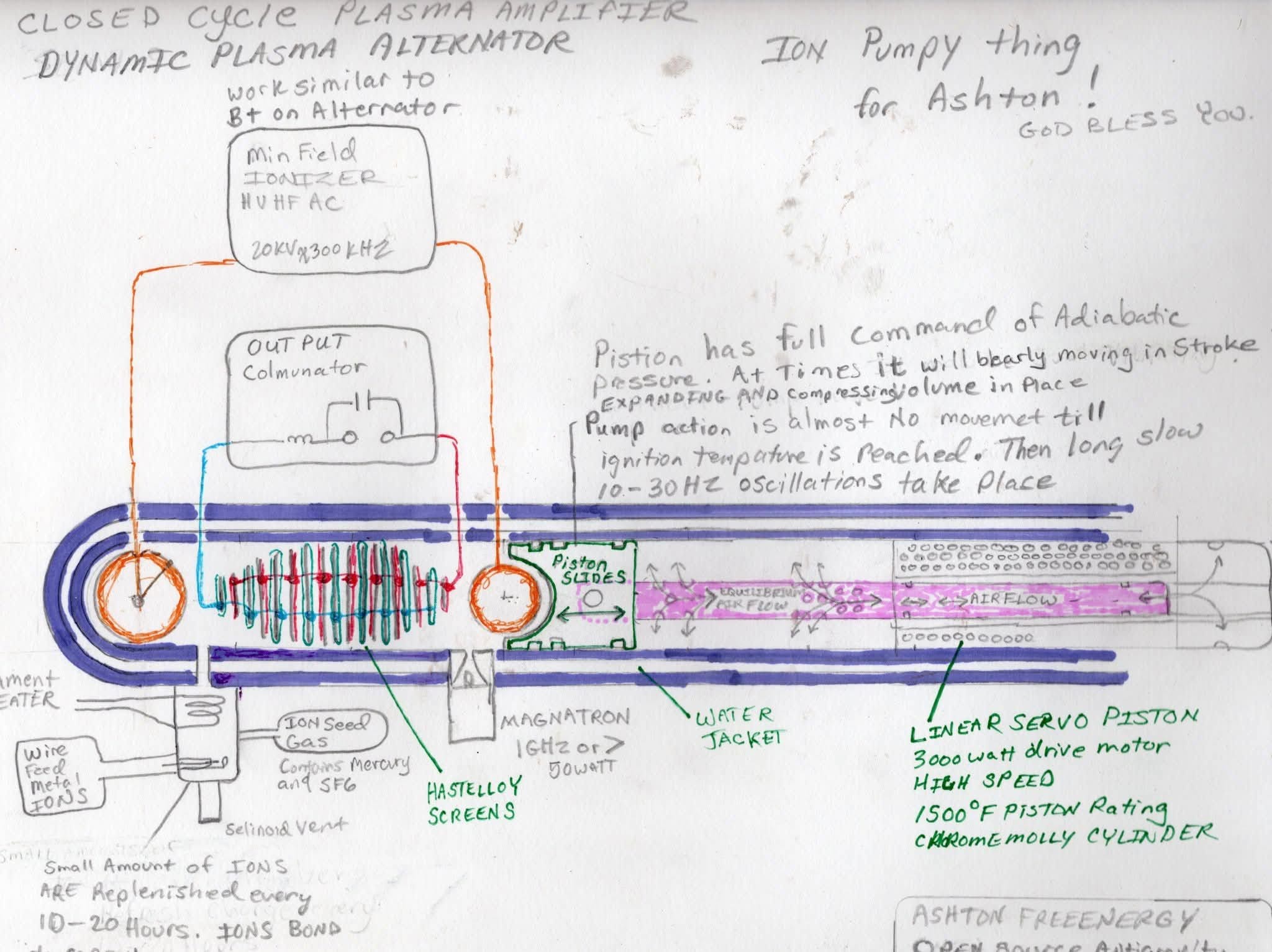
TL;DR: This drawing does not look like a conventional engine sketch. It looks like an attempt to build a controlled ionization tube where plasma, pressure, airflow, pulsed power, and a moving piston are all being forced into one resonant cycle. From a Frequency Wave Theory perspective, the core idea is not combustion first. It is medium-conditioning first. The device appears to aim at creating a structured plasma channel, then using oscillation, compression, and ionized flow to amplify force and reduce normal resistance. Whether it would actually work as drawn is unproven, but the physics idea behind it is clear: change the state of the medium, and motion becomes easier.
What stands out immediately is that the sketch mixes several domains into one machine. It shows an ionizer, high-voltage high-frequency AC, an output commutator, a magnetron, ion-seed gas, airflow, a water jacket, Hastelloy screens, and a linear servo piston. That combination suggests the designer was not thinking like a normal engine builder. They were thinking in layers: first ionize the working medium, then compress or organize it, then drive oscillation through a tube, then let the resulting pressure-field interaction produce thrust or amplification. In other words, this is not just a pump. It is trying to be a field-organized plasma alternator.
From a Frequency Wave Theory perspective, the most important phrase on the page is not even the hardware. It is the repeated implication of cyclic control. “Closed cycle plasma amplifier.” “Dynamic plasma alternator.” That means the device is trying to create a repeating resonant event, not a one-time discharge. In FWT terms, that is the difference between wasting energy and building coherence. A normal engine burns fuel and throws mass. A field-oriented device tries to create a stable oscillatory pattern in the medium itself. If that pattern becomes coherent enough, the machine no longer relies purely on brute-force push. It begins to ride the pressure gradient and plasma geometry it creates.
The piston notes are especially revealing. The text suggests the piston has “full command of adiabatic pressure,” with very little movement until ignition conditions are reached, followed by slower oscillations around 10–30 Hz. That sounds like an attempt to separate the ignition or ionization phase from the larger pressure-stroke phase. In FWT language, this would be a two-regime system: a fast electromagnetic/plasma regime setting up the field structure, and a slower mechanical regime harvesting or stabilizing the pressure response. That is actually a very interesting concept. The designer seems to be imagining that once the gas is ionized and phase-conditioned, the piston does not need to fight the full burden of raw compression in the normal way. It only needs to maintain the resonance window.
The ion-seed gas note is another major clue. The sketch mentions mercury and SF6, along with wire-fed metal ions. That implies the designer wanted to tune conductivity, breakdown behavior, and plasma persistence. In ordinary terms, they were trying to make the gas easier to ionize and easier to control. In FWT terms, this is medium preparation. The machine is not treating gas as passive fuel-air mixture. It is treating gas as an active waveform carrier. Seed it correctly, excite it correctly, and the tube becomes less like a cylinder and more like a guided resonant channel.
The magnetron and high-frequency ionizer matter for the same reason. They imply microwave or RF energy being used to sustain ionization or shape the plasma zone. That fits the purple central channel drawn in the tube, labeled with equilibrium airflow. The visual message is that there is supposed to be an organized core region where the flow is no longer ordinary turbulent gas. It becomes a confined energetic stream. If that was the real design intent, then the goal was likely to produce a lower-resistance, more coherent transport core inside the chamber. That is pure FWT logic: motion improves when the medium is driven toward ordered coherence instead of chaotic compression alone.
The strongest FWT explanation is this: the sketch is trying to create a machine where plasma lowers the effective coupling resistance of the working fluid, pulsed energy organizes the flow into a coherent channel, and mechanical oscillation extracts thrust or amplification from the resulting adiabatic pressure gradients. The designer is basically reaching for a hybrid between an engine, a plasma tube, and a resonant field device. That does not mean the exact build would function. There are obvious engineering problems here, including thermal stress, electrode erosion, plasma instability, material compatibility, and control complexity. But the underlying idea is not nonsense. It is an intuitive attempt to turn propulsion into medium engineering.
That is why this sketch matters. It shows the same conceptual leap that keeps appearing in advanced propulsion discussions: the future of motion may not come from pushing harder, but from reorganizing the field around the motion itself. In Frequency Wave Theory terms, that means using oscillation, ionization, and pressure-phase control to reshape how energy couples into matter. The real ambition of this drawing is not just to make a pump. It is to make the medium obey.


